


The income statement is retained earnings statement often used by corporations in place of a statement of retained earnings. This statement details the company’s revenue, expenses, and net income over a specific period, providing insights into its profitability. By revealing whether a company can grow using its own steam or if it might stumble into financial distress, the statement acts to build or diminish market and shareholder confidence. Within a company, these numbers illustrate management’s prowess in using profits effectively and deciding on dividend distributions. And when it comes to crunch time for fundraising, loans, or investor negotiations, the statement of retained earnings can prove to be an invaluable testament of the company’s ability to pay its own way. Retained earnings represent the total profit to date minus any dividends paid.Revenue is the income that goes into your business from selling goods or services.
The Most Popular Accounting & Finance Topics:
- However, for those seeking capital appreciation, a high dividend payout ratio may not align with their investment goals and could potentially impact the company’s reinvestment in long-term growth initiatives.
- While it has paid out $90,000 in dividends over two years, it has continued to build its retained earnings balance.
- It serves as a clear indicator of a company’s financial health and indicates how much profit has been kept on the books over a specific period.
- To build an accurate balance sheet, you’ll need to sort your accounts into short-term (current) and long-term (non-current) categories.
- Let’s say your business has beginning retained earnings of $10,000 and net income of $4,000.
- By examining the statement, investors can gain insights into how a company intends to use its profits for future growth.
- Opening with the correct balance is vital as it sets the groundwork for the subsequent calculations.
When a company changes its accounting principles, it must adjust retained earnings to reflect the cumulative effect of the change. Another way to make sure you have the right numbers on hand includes using CFO dashboard tools or consulting your last CFO report. Both of these options ensure you have some helpful KPIs on hand and give you a broader look at your company’s overall financial health. Make sure to have ‘add’ before net income since it represents money coming into the business and ‘less’ before dividends because of money going out. In this article, we’re giving you an in-depth guide to statements of retained earnings and how you can prepare one in three steps.

The Retained Earnings Statement: What Does It Contain?
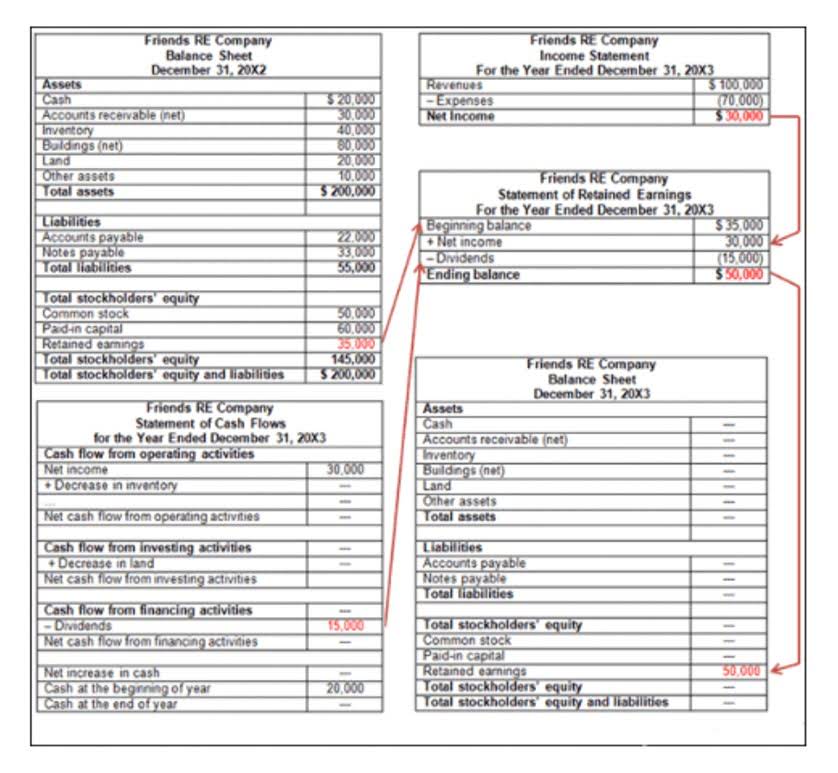
It can reinvest this money into the business for expansion, operating expenses, research and development, acquisitions, launching new products, and more. The specific use of retained earnings depends on the company’s financial goals. Ultimately, the company’s management and board of directors decides how to use retained earnings. Don’t forget to record the dividends you paid out during the accounting period.
- The steps to calculate retained earnings on the balance sheet for the current period are as follows.
- If retained earnings are low, it may be wiser to hold onto the funds and use them as a financial cushion in case of unforeseen expenses or cash flow issues rather than distributing them as dividends.
- Prolonged periods of declining sales, increased expenses, or unsuccessful business ventures can lead to negative retained earnings.
- Retained earnings specifically apply to corporations because this business structure is set up to have shareholders.
- A retention ratio of 75% implies that Company D reinvests three-quarters of its net income into the business, which can lead to significant growth in retained earnings over time.
What Is Net Income and How Is It Calculated in Accounting?
Knowing how that value has changed helps shareholders understand the value of their investment. They are a measure of a company’s financial health, and they can promote stability and growth. On one hand, high retained earnings could indicate financial strength since it demonstrates a track record of profitability in previous years. On the other hand, it could be indicative of a company that should consider paying more dividends to its shareholders.
- For C-suite leaders, it’s a strategic tool that keeps you aligned with the company’s trajectory—ready to make decisions that drive immediate impact and long-term success.
- These payouts are like a “thank you” to the investors who bank on your success.
- Therefore, a company with a large retained earnings balance may be well-positioned to purchase new assets in the future or offer increased dividend payments to its shareholders.
- They show how healthy a company’s finances are and can help it stay stable and grow.
- A retained earnings statement is one concrete way to determine if they’re getting their return on investment.
Relation With Income Statement

This information is essential for investors and stakeholders who are keen on understanding the company’s financial health and growth prospects. A statement of retained earnings is a financial document that outlines the changes in a company’s retained earnings over a specific accounting period. It reveals the movements in earnings retained within a business for reinvestment or future use rather than being distributed retained earnings balance sheet to shareholders as dividends. Understanding the statement of retained earnings is crucial for investors as it offers insights into a company’s financial health and growth potential.
- You can find the amount on the balance sheet under shareholders’ equity for the previous accounting period.
- Just like in the statement of retained earnings formula, find the total by adding retained earnings and net income and subtracting dividends.
- If you don’t pay dividends, you can ignore this part and substitute $0 for this portion of the retained earnings formula.
- In essence, retained earnings are a reflection of your company’s success story and foresight.
- The key to a successful internal reinvestment strategy is to identify sectors within the business with the highest potential for growth and allocate resources accordingly.
During the accounting period, the company generates a net income of $50,000 and pays cash dividends of $20,000, leaving it with $30,000 of its net income remaining. At the end of a given reporting period, any net income that is not paid out to shareholders is added to the business’s retained earnings. One of the most essential facts of business is that companies need capital to grow. For many companies, some of that capital comes from retained earnings—the portion of profits a company keeps instead of paying it out to shareholders. When Business Consulting Company will prepare its balance sheet, it will report this ending balance of $35,000 as part of stockholders’ equity.

A consistently growing retained earnings balance suggests that the company is profitable and reinvesting wisely. Conversely, a declining retained earnings balance might indicate financial struggles or overly generous dividend policies that could undermine long-term growth. Retained earnings are influenced by various factors, including net income, dividend payments, and any adjustments due to accounting changes or corrections. By tracking these changes, the Statement of Retained Earnings helps in assessing the company’s ability to generate sustainable profits. It also aids in making informed decisions regarding future investments and dividend policies. These earnings are considered “retained” because they have not been distributed to shareholders as Remote Bookkeeping dividends but have instead been kept by the company for future use.
It provides information about the company’s profit retention, dividend policy, and overall financial condition. The statement of retained earnings (retained earnings statement) is an essential financial document that reports changes in a company’s retained earnings over a given period. This article will address some common questions and misconceptions regarding the statement of retained earnings, providing clarity to investors and analysts. A high retention ratio signifies that a company has reinvested a large proportion of its profits back into the business, while a low ratio indicates the opposite. A high retention ratio can be beneficial for companies in growth stages or capital-intensive industries, as it allows them to invest more in asset expansion and research and development. However, if a company consistently maintains a very high retention ratio, investors might start questioning whether management is effectively utilizing the retained earnings.
Learn how to build, read, and use financial statements for your business so you can make more informed decisions. The retained earnings are calculated by adding net income to (or subtracting net losses from) the previous term’s retained earnings and then subtracting any net dividend(s) paid to the shareholders. If the company had not retained this money and instead taken an interest-bearing loan, the value generated would have been less due to the outgoing interest payment. Retained earnings offer internally generated capital to finance projects, allowing for efficient value creation by profitable companies. However, note that the above calculation is indicative of the value created with respect to the use of retained earnings only, and it does not indicate the overall value created by the company. Retained earnings are the portion of a company’s cumulative profit that is held or retained and saved for future use.
A business borrower may be subject to loan covenants based on these ratios. Unless a lender waives a ratio-based covenant violation, it can result in penalties, higher interest rates or even default. This guide also shows you some accounting dashboard examples, and how to create one. Click here to learn how to track, analyze, and improve these KPIs for better results. Use these tips to improve business management skills, enhance employee engagement, and build a stronger foundation for organizational success. But double-checking accuracy is wise, especially after changes to past statements.